
Grass Valley: Rewriting the rules of game day
What does it take to produce more than 150 live sports events every year? For leading universities, the answer lies in broadcast-grade IP technology
It’s becoming increasingly apparent that broadcast-grade technology is no longer confined to major networks and global sporting events. Now, it’s rapidly becoming a crucial component of collegiate athletics, where universities are producing content at a quality that even rivals professional operations. This is no more apparent than across three recent deployments in the US at the University of Illinois, University of Pittsburgh and Texas A&M. Using tools from broadcast tech powerhouse Grass Valley, one theme from these projects stood out: the continued move toward future-proof infrastructures is serving to empower both students and professionals to operate at the highest level.
Upgrade without upheaval
At the University of Illinois, the challenge wasn’t just about upgrading, it was about doing so within the constraints of an existing facility while laying the groundwork for long-term growth. Partnering with TAB M Solutions, Grass Valley delivered a hybrid SMPTE ST 2110/SDI environment that strikes a careful balance between innovation and operational familiarity.
The deployment includes native SMPTE ST 2110 workflows powered by LDX 150 cameras, alongside a CCS-ONE camera control system, which centralises shading and enables remote monitoring. By eliminating traditional baseband CCUs, the system reduces both rack space and thermal load – critical considerations in a constrained control room environment.
For Fighting Illini Productions, the impact is instant and strategic. As its associate director of athletics Derryl Myles explains: “Our objective was to elevate our game-day production while positioning Fighting Illini Productions for long-term growth. The hybrid architecture allows us to incorporate IP strategically while still maintaining familiar workflows, and the LDX 150 cameras provide the image quality, flexibility and performance needed to meet the expectations of the Big Ten as well as the fanbase.”
This ‘intentional transition strategy’, as described by TAB M Solutions partner and CTO Kevin Tucker, highlights a key trend in education: universities are not simply replacing legacy systems, they are evolving them. “The hybrid 2110/SDI architecture preserves operational familiarity while leveraging IP where it creates tangible benefits. Deploying the LDX 150 cameras natively over 2110 reduced rack space, heat load and integration complexity while creating a scalable foundation for future expansion.”
Pittsburgh powers up
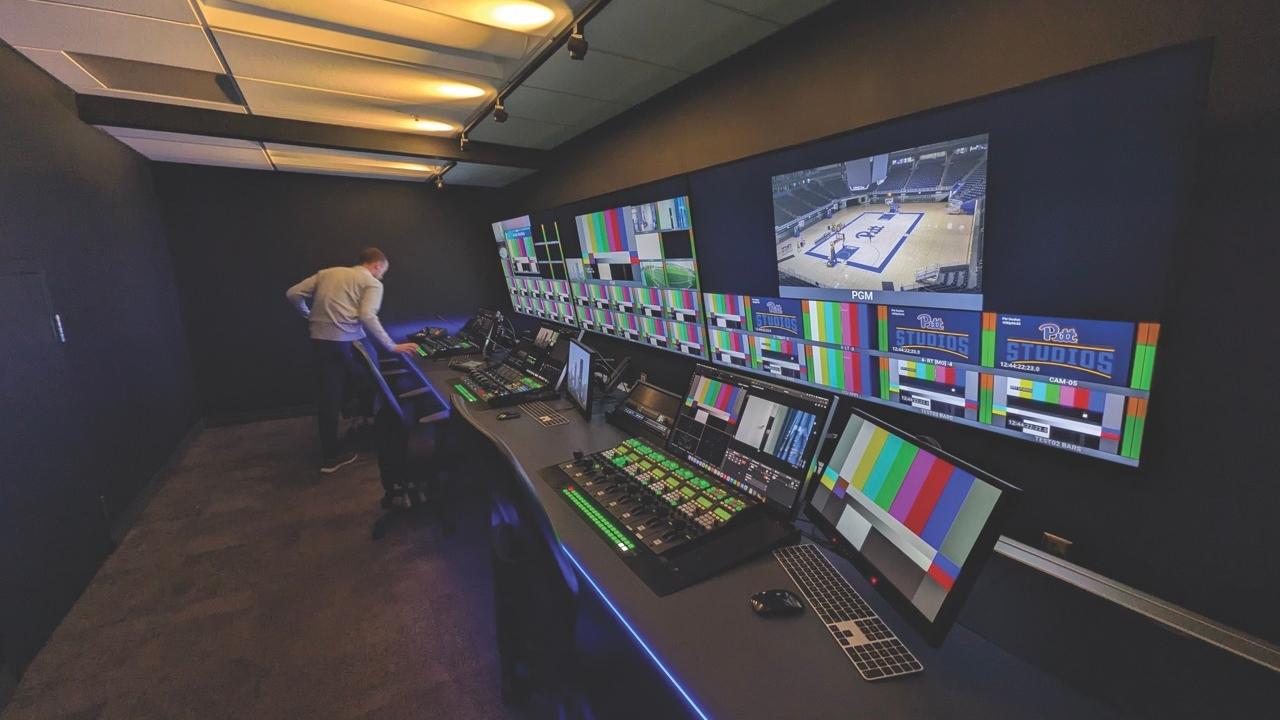
If Illinois represents a carefully phased evolution, the University of Pittsburgh shows what full IP transformation looks like within a high-demand environment. Supporting more than 150 live events annually across 19 NCAA Division I programmes, Pitt Athletics required a system that could handle scale and complexity.
Grass Valley’s solution centred on a complete transition to a SMPTE ST 2110 IP backbone, anchored by K-Frame XP switcher architecture. The upgrade enables six switcher suites across control rooms, with shared processing, expanded ME capacity and enhanced resilience.
Importantly, this latest deployment followed pre-existing investments. Pitt’s original LDX 86 cameras, installed in 2018, were seamlessly integrated into the IP infrastructure, demonstrating the longevity and adaptability of Grass Valley systems.“With over 150 events annually, our production demands continue to grow across both broadcast and in-venue platforms,” says director of operations and strategy, University of Pittsburgh athletics, Patrick O’Shea. “The original LDX 86 installation allowed us to operate in 1080p from day one, and this upgrade now positions us for IP, HDR and expanded slow-motion capabilities.”
From an engineering perspective, the transition to IP unlocks new efficiencies. Tucker notes: “By leveraging Grass Valley’s K-Frame XP ecosystem in a full 2110 architecture, we were able to centralise resources, increase capacity and create a clear path toward HDR and expanded super slow-motion workflows.”
Built to scale
At Texas A&M, the focus shifted, with the main goal being to build a forward-looking production ecosystem that bridges today’s needs with tomorrow’s possibilities.
The university deployed a suite of Grass Valley solutions, including K-Frame X switchers, LDX 135 cameras and LDX 150 cameras, creating a robust foundation for high-quality 1080p production with a clear upgrade path to UHD.
12th Man Productions’ associate athletic director Andy Richardson emphasises how, originally, “12th Man Productions first invested in Grass Valley camera technology in 2014 when we upgraded our facility to support the Videoboard shows and ESPN/SEC Network live event programming for Texas A&M Athletics. In 2024, as we turned over a new page in technology by upgrading our live camera systems to support IP 2110 infrastructure and transitioning to HD 1080p, we saw Grass Valley as the ideal partner to elevate our productions. And we couldn’t be happier with the results.”
Crucially, the integration was not only for immediate results, but also long-term growth. As Tony Gaston of Diversified tells us: “This deployment not only meets the university’s current needs, but also sets the stage for future technological growth.”
Airwaves to athletics
Taken together, these three projects illustrate a seismic shift in the role of broadcast technology within education. Universities are no longer just training grounds, they are fully fledged production hubs, delivering professional-grade content across linear, digital and in-venue platforms. And it’s also clear that Grass Valley’s IP-enabled ecosystem – cameras, switchers and control systems – provides a sophisticated technical foundation for this evolution.
As Greg Doggett, VP of sales NAM sports at Grass Valley, summarises: “Across Illinois, Pittsburgh and Texas A&M, we’re seeing a clear shift in how collegiate programmes approach live production. These projects show how flexible, IP-based infrastructures can scale from hybrid environments to full ST 2110, providing the performance teams need today while creating a path to future workflows.”
Visit grassvalley.com for more information.
Share this story


