
Sony and Norwich University of the Arts climate project
Norwich University of the Arts collaborated with Sony to bring the long-term impact of sea-level rise into focus through an immersive installation at Southbank Centre’s inaugural Creative Intelligence Festival, held in London from 11th –13th September 2026.
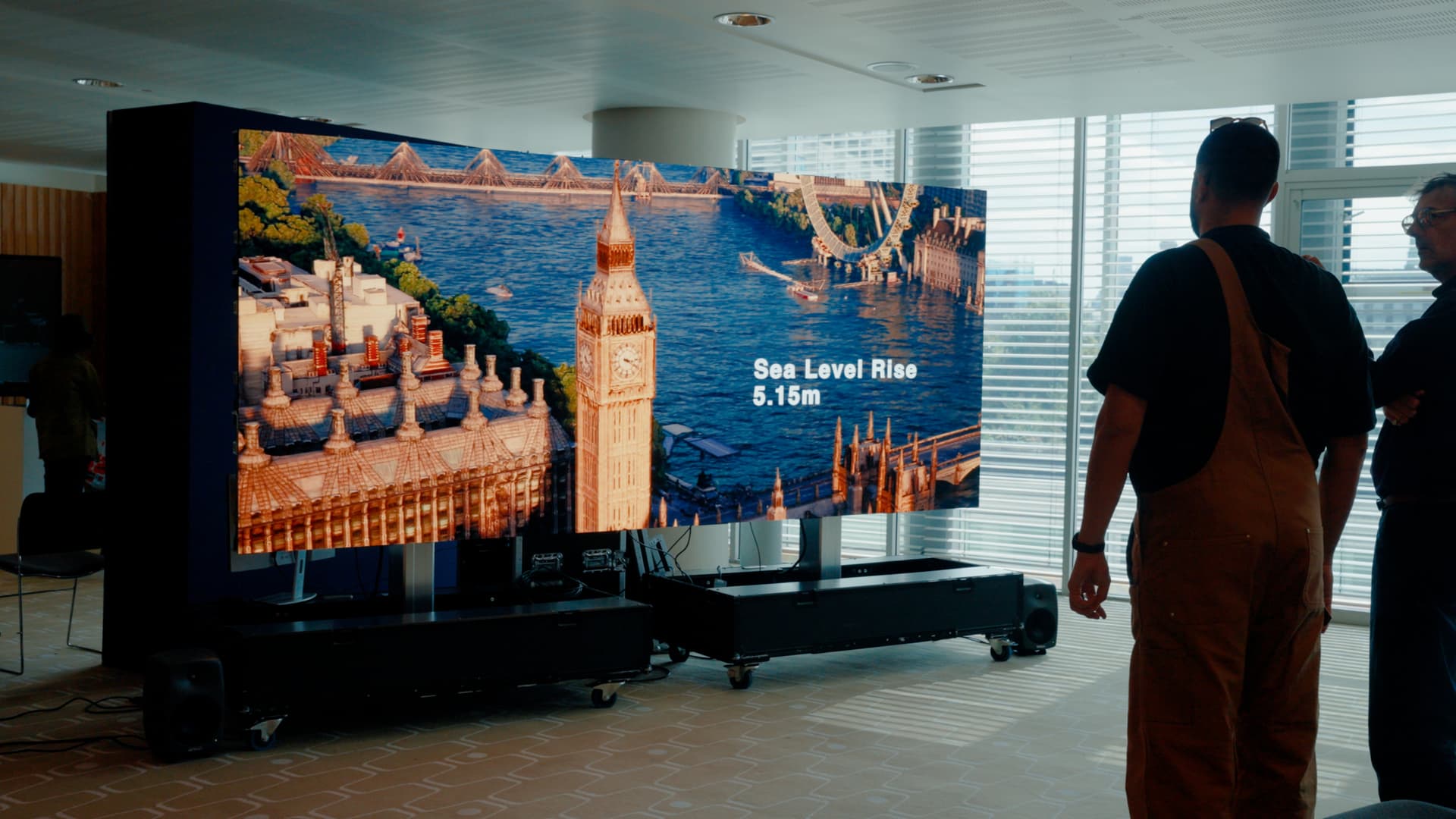
Combining a 9m x 4m VERONA Crystal LED display with Sony’s glasses-free Spatial Reality Display, the project presented two complementary ways to experience a changing London. Large-scale city imagery offered a shared viewing experience, while detailed 3D scenes invited visitors to explore the visualisation more closely, without a headset or handheld controller.
The installation translated a 400-year sea-level-rise cycle into a concise animation, showing how familiar landmarks, bridges and buildings could become submerged within around 100 years in the visualisation. By making a distant environmental challenge feel immediate, the project aimed to encourage reflection on the need for action today.
Norwich University of the Arts wanted to make the consequences of climate change and future sea-level rise less theoretical. Drawing on the University’s climate visualisation research, the team set out to communicate change across a long timeframe in a format that audiences could understand quickly and connect with emotionally.
“Through our collaboration with Sony, this project provided an opportunity to explore how cutting-edge visualisation technologies can transform the communication of environmental challenges, creating experiences that are both technically sophisticated and immediately engaging,” says professor Louis Nixon, dean of research and knowledge exchange, Norwich University of the Arts. “Working with Sony to create these two pieces for the Southbank Centres First Creative Intelligence Festival gave us the opportunity to explore not just the technology, but how it can change the way people engage with difficult and often abstract subjects such as climate change and future environmental risk.”
The final exhibition had to offer an intuitive experience without placing specialist viewing equipment between visitors and the story. Sony’s VERONA Crystal LED display presented the changing city at a scale designed to make the potential loss of familiar infrastructure visually clear. Measuring 9m x 4m and comprising of 140 panels, the display used 6.7 million pixels to deliver detailed, cinematic imagery for viewers.
Alongside it, Sony XYN’s Spatial Reality Display offered a more intimate encounter for visitors who could stand in front of the display and look around the 3D scenes, experiencing depth without the need for glasses, a headset or a handheld controller.
The two presentation formats balanced the impact of a large-scale installation with individual exploration. Together, they helped move the climate narrative beyond technical information and into an experience audiences could engage with directly.
The team combined single-camera photogrammetry, Google Earth data and Gaussian splatting to create distinctive, dreamlike 3D scenes of London. Sony’s involvement extended beyond the displays themselves. The collaboration brought Spatial Reality Display into the workflow, with shared expertise helping the team explore new applications, simplify setup and develop the public experience.
“What impressed me most was the ability of the technology to remove many of the traditional barriers between the viewer and the content. Rather than asking an audience to interpret technical information, the displays enabled them to experience it directly, creating a much deeper level of engagement and understanding,” continues Nixon.
The completed installation demonstrated how advanced visualisation can support the communication of complex environmental research. By showing recognisable parts of London becoming non-existent, the experience aimed to make future risk easier to understand and encourage audiences to consider its implications.
The project also widened access for visitors, pairing cloud-enabled production with glasses-free viewing. Following the showcase, the University team is exploring opportunities to replicate the setup for future exhibitions and public engagement, including a portable installation to bring the visualisation to new audiences.
“Equally important was Sony’s collaborative approach throughout the project. Their team demonstrated a genuine willingness to share expertise, explore new applications and work alongside us to achieve the best possible outcome. From a research and innovation perspective, that openness was invaluable, allowing us to test new ideas and better understand the potential of these technologies beyond their traditional use cases,” comments Nixon.
“Working with Norwich University of the Arts on this project has been a fantastic opportunity to bring creative research and Sony’s visualisation technology together,” adds Hitomi Hamaba, product marketing & business development manager at Sony Europe. “The team’s willingness to share ideas and explore new possibilities made this a genuinely collaborative effort, with a clear purpose: to make a complex environmental challenge more tangible and engaging for the public. For Sony, projects like this are important because they show the potential of our technology beyond its traditional applications. By combining the scale of VERONA Crystal LED with the depth of Spatial Reality Display, we can help researchers and creators tell powerful stories in new ways. We’re proud of what we’ve achieved together and excited by the potential to bring these experiences to wider audiences.”


