
Building the modern newsroom
News broadcast studios may look glamorous from the outside – but what about the hidden solutions powering that glossy, new glow?

25.04.2026
8 min read

Building a newsroom in 2026 isn’t about racks of hardware and tangled cables any more, it’s about agility and speed. Over the last few years, an industry-wide shift to software-defined, IP-based infrastructure has been quietly transformational in terms of its impact on news broadcast, completely reinventing the ways in which stories are produced. Now they are often packed full of powerful AI enhancements that take care of the repetitive aspects of newscasting past so teams can focus on what matters most: the storytelling.
Similarly, virtual production has come to the forefront, enhancing the look and feel of newsrooms, which for many years took on a familiar format. Physical sets are giving way to immersive environments, built from LED volumes, XR and dynamic visuals that can change in an instant.
With so many trends, workflows and solutions influencing that monumental change, we’re here to dig into the most consequential tools giving today’s newsrooms their polished, new looks.
Great expectations
“Broadcasters must deliver consistent output across linear television, digital platforms and social channels simultaneously, often from multi-site production environments,” begins Tehseen Akhtar, senior director of graphics at Ross Video. “One of the most common challenges is ensuring the many cogs involved in news production, from newsroom systems to graphics engines and automation, work together seamlessly.”
Another obstacle that Akhtar points to is managing infrastructure costs while maintaining production quality. “Broadcast organisations are under pressure from changing audience habits and growing competition from digital media,” adds Akhtar. “That means technology decisions have to balance performance with long-term financial sustainability. Newsrooms need systems that can scale when coverage expands during major events but remain efficient when demand is lower.”
News places unique demands on production workflows. Stories develop quickly and editorial teams must respond in real time while maintaining accuracy and clarity. According to Akhtar, graphics are a crucial part of that process because they help audiences quickly understand developing stories, but they also need to be created and updated at speed.
“One challenge is ensuring that editorial teams can produce graphics without slowing down the newsroom workflow,” says Akhtar. “Historically, creating broadcast graphics often required specialist operators and multiple production steps. Today’s news environments require far more streamlined approaches where journalists, producers and graphics teams can collaborate quickly and update information as events unfold.”
Data integration is another important factor. “Many news graphics rely on live or frequently updated data such as election results, financial figures or breaking developments. Ensuring that this information is reliable and clear requires strong technical integration and careful editorial oversight.”
“Audiences expect complex information to be presented clearly and visually, particularly when stories involve data, weather, geography or rapidly changing developments,” says Akhtar. As a result, graphics are becoming more integrated into editorial workflows rather than being treated as separate production elements.
One approach that has proven effective for Akhtar and the team at Ross Video has been through centralising graphics infrastructure so multiple studios, programmes or regional operations can all access the same tools and design resources.
“In practice, this means editorial teams can work from shared templates and data sources, allowing graphics to be created quickly while maintaining consistent branding across different programmes,” he tells us. “This centralised approach also helps organisations manage resources more efficiently and adapt their production capacity when major news events require expanded coverage.”
“Instead of committing entirely to one model, many organisations are evaluating how different financial and operational approaches can support their evolving production needs,” says Akhtar. “These shifts are helping newsrooms respond more effectively to changing editorial demands, while still maintaining control over long-term technology planning.”
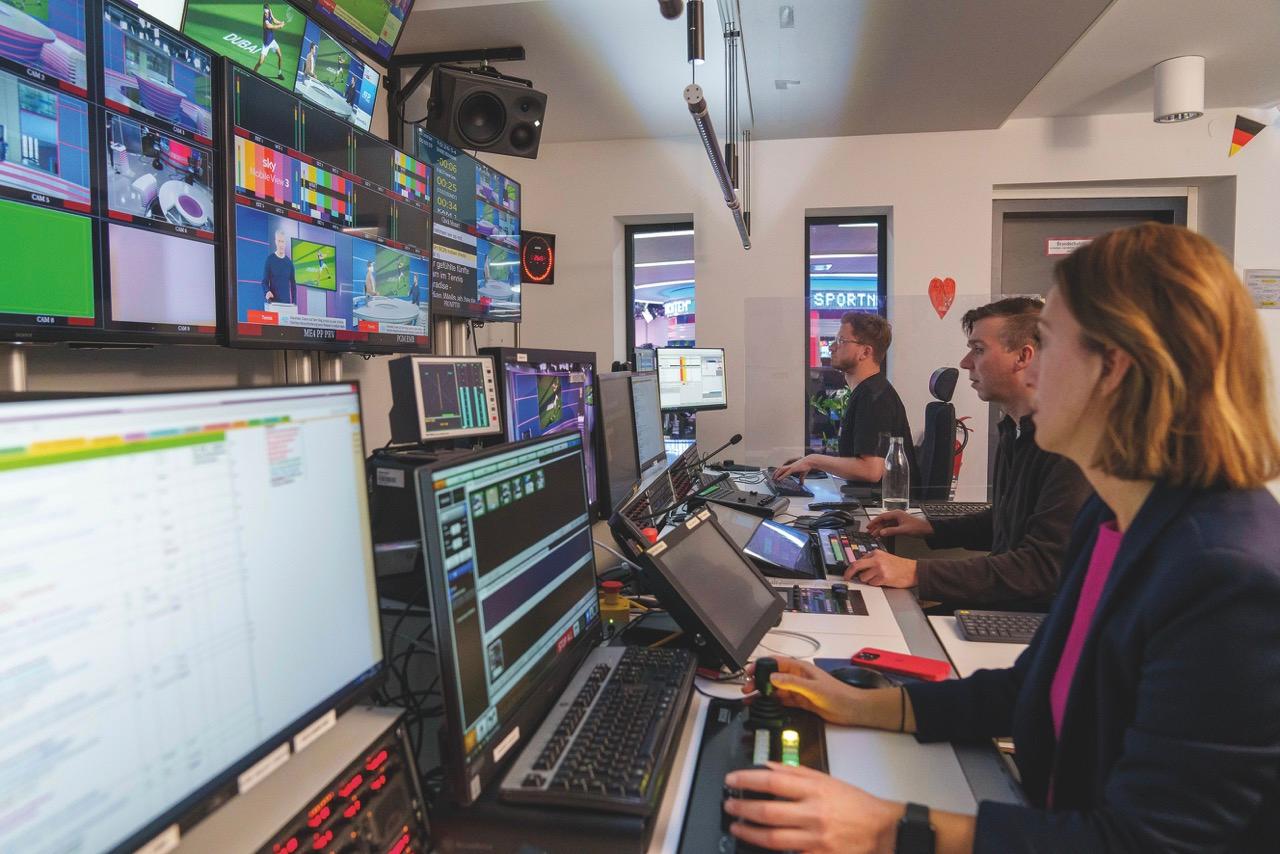
Sky News Germany
Goodbye green screens!
Not so long ago, the faint green tinge outlining most news anchors (especially the weather reporters!) was simply just a part of the newsroom furniture. But now, studios have moved away from the green-screen approach towards cutting-edge virtual sets and LED volumes, making them increasingly interactive in their storytelling capabilities.
As well as this, the motion and robotics enabling them have seen swathes of improvement across many mainstream news studios. Robotic camera systems are often associated with sports or entertainment; however, according to Paddy Taylor, head of broadcast at Mark Roberts Motion Control (MRMC), data shows around 70% of TV stations in the US have already invested in camera robotics. A more cinematic approach to broadcast seems to be the current expectation; Taylor is here to explain why.
“It’s part of a strong trend towards visual storytelling techniques, where sweeping reveals, parallax camera arcs, cinematic shot transitions and various creative camera moves are used to add energy and depth. Traditionally, achieving anything close to current levels of visual sophistication would only have been possible for the most well-funded productions with access to large studio spaces, rail systems, jib cranes and the like.”
The arrival of robotic camera systems changed the newsroom game entirely, by bringing innovation to much smaller studio environments, including regional and local news studios. “For example, modern systems have introduced multi-axis motion, allowing multiple types of movement to occur within the same shot,” adds Taylor.
News productions can also incorporate compound camera motion. For presenter shots, robotic systems can orbit around an anchor desk while maintaining framing using real-time target tracking. “This is all highly repeatable; the same shot can be executed consistently across broadcasts,” says Taylor. “These systems have established themselves as a vital part of contemporary, high-quality and creative news production.”
Taylor argues that camera tracking and motion precision are quickly rising up the priority list across the industry. “Robotic camera systems are fundamental to supporting the workflows involved, particularly because of their compatibility with AR/VR tracking and ease of integration with virtual sets and digital set extensions.”
Delivering these experiences requires accurate camera movement and positioning to maintain alignment between real cameras and virtual graphics environments. “To help achieve this, robotic systems provide extremely precise and, crucially, repeatable camera motion so shots always match the appropriate digital element,” says Taylor.
They also support real-time target tracking to maintain consistent framing when presenters move within augmented or virtual studio spaces. “Bringing this all together requires a very high level of technology and process integration, with modern camera robotics designed to integrate seamlessly into the wider production setting rather than operating as stand-alone systems.”
ITN was the first production company to deploy MRMC’s StudioBot LT as part of ITV’s overnight general election programme on Thursday 4 July 2024. “The StudioBot LT is a recent addition to MRMC Broadcast’s range of robotic arm solutions,” says Taylor. “It was the first time it had been used in a live programme of this kind, serving as a bridge between the two main ITV studios used on the night. The ITV overnight programme was on air from around 10pm, following the exit poll, through to 6am on Friday to cover the general election results as they came in.”
Al Jazeera also made the decision to deploy MRMC’s StudioBot XL robotic arm as part of a new studio infrastructure designed to support more ambitious visual storytelling. “Replacing a manual dolly and crane-based workflow in one of the network’s flagship studios in Doha, the system gave the production team a greater range of motion and the ability to execute consistent, pre-programmed camera moves. With a large operating envelope and the capacity to support full-size broadcast cameras and teleprompters, it enables Al Jazeera to create more dynamic shots, which are now used being used across a wide range of their programming.”
Automated systems are already well on their way to becoming part of the standard newsroom infrastructure. “While automation is a rapidly growing trend, plenty of broadcasters continue to operate hybrid production models that combine automation-driven workflows with the ability for operators to take direct manual control when required,” says Taylor. “Robotic camera systems support this model by allowing precise repeatable motion in automated workflows while still enabling manual operation.”
Breaking news needs resilient tech
As the pace of change in news continues to accelerate, audiences now expect information instantly.
“That places greater importance on technology and workflows that empower editorial teams to work quickly and confidently,” adds Akhtar.
At the same time, broadcasters must make careful decisions about how they invest in production technology. Akhtar stresses that financial sustainability and long-term reliability are all crucial considerations. Technology should enable newsrooms to adapt to changing demands rather than forcing them into rigid production models.
“Looking ahead, the most successful news organisations will likely be those that combine strong journalism with adaptable technology strategies,” concludes Akhtar. “By focusing on efficient workflows, scalable infrastructure and clear visual storytelling, broadcasters can continue to deliver the timely and trusted news coverage that audiences rely on.”
This article appeared in our NAB 2026 issue


