
Ready for blast off: Rocket launches meet remote production
Remote production is the new norm, letting broadcasters work from almost any location, including rocket ships, launch pads and landing sites. That’s what Broadcast Management Group is doing with Blue Origin’s space flights

|17.03.2026
5 min read
In spring 2025, for the first time since 1963, an all-female crew (that included Lauren Sánchez, Aisha Bowe, Kerianne Flynn, Gayle King, Amanda Nguyen and Katy Perry) visited outer space. The sub-orbital flight – known technically as Blue Origin’s New Shepard 31 – launched from Van Horn, Texas and, thanks to Broadcast Management Group, was broadcast live to an international audience.
“We were contacted in April of last year by Blue Origin,” begins Todd Mason, CEO of Broadcast Management Group, who was given less than two weeks to pull a production together. “They wanted everything done on location. It was pretty expensive because of the travel alone. We had to bring in the power, a set truck – we created it all.”
BMG’s NS-31 solution included NEP Denali mobile units, a multi-camera configuration, a comms system and a fibre optic network. Pre- and post-launch coverage was combined with a live feed of the blast-off, too. “Blue Origin was over the moon,” he shares. “No pun intended.”
Taking flight
After NS-31’s success, Blue Origin tapped BMG for future space flights, aiming for a once-a-month production schedule. For Mason, the main issue was, once again, cost. “Doing a special is one thing. When you want to do it with frequency, you need to get the cost down. We’re pioneers in centralising technology and decentralising production teams, so the next launch we did was REMI,” he shares. REMI (remote integration model) can otherwise be known as remote live production.
BMG executed two fully cloud-based REMI broadcasts on Blue Origin’s next missions: NS-32 and NS-33. Unlike NS-31, NS-32 “included 27 camera feeds coming from Texas to our network operation center in DC, where we produced the live broadcast,” Mason recounts. “We flew out a couple of engineers to be on site. Everything else was controlled from DC, and the broadcast was equally spectacular” to NS-31’s, he suggests. NS-33, which aired a few weeks later, used the same set-up.
Again launching from Van Horn, BMG combined the 27 live camera feeds with four feeds coming from its studio in Kent, Washington. These were routed to the NOC in real time. “It’s a complete production ecosystem and our own private cloud data centre here in DC,” states Mason. They used it again on New Glenn.
Reaching new heights
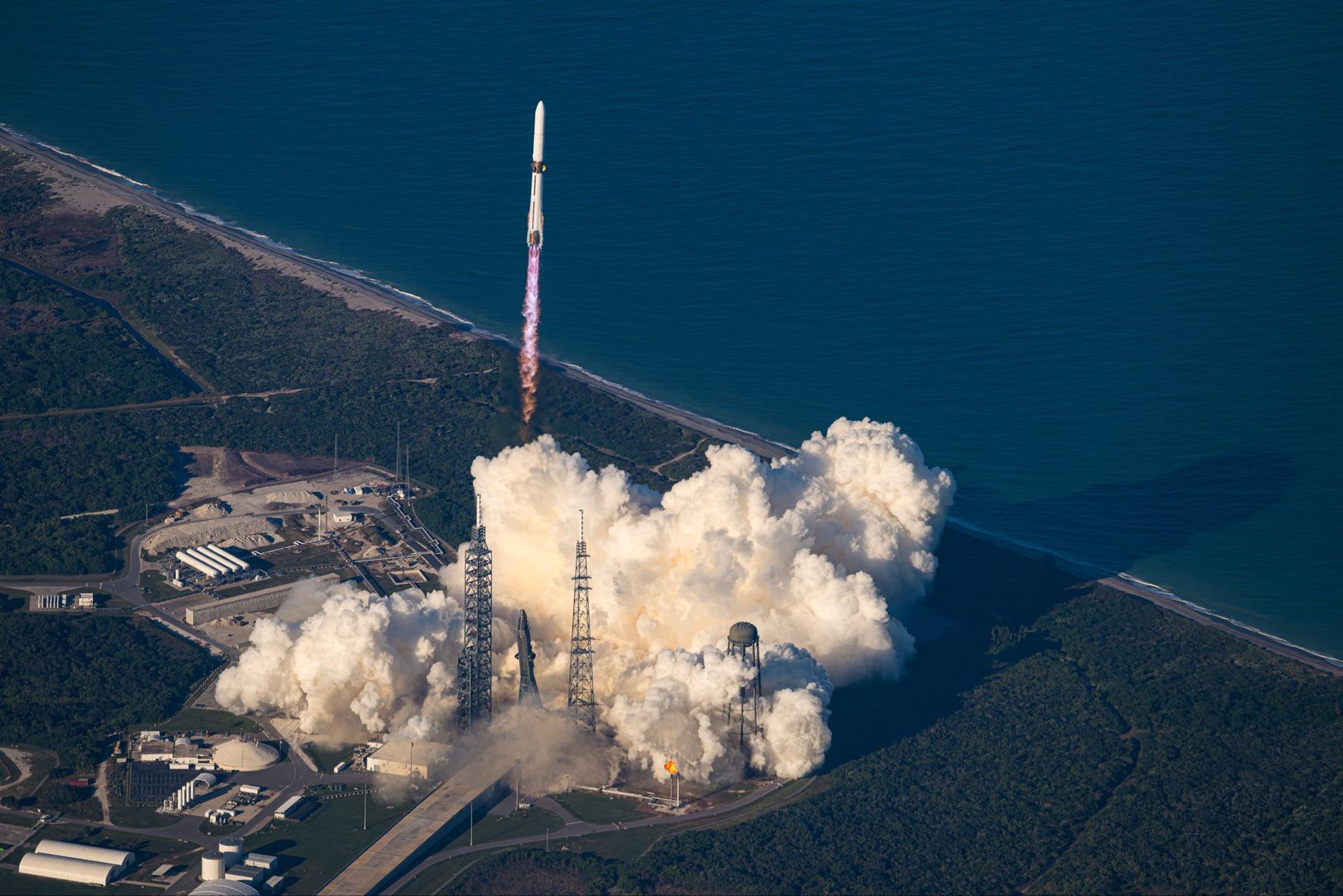
After three successful New Shepard missions, BMG levelled up to New Glenn, a larger rocket that carries crews to the moon and payloads to Mars. “Their mission was to launch the rocket, release the payload that would continue on and then the booster would come back and land on a barge at sea,” explains Mason. “The first time they did it, that did not happen. The second time, it did.” NG-2 launched on 13 November 2025, successfully propelling NASA’s ESCAPADE twin spacecraft into orbit while landing its booster – marking a giant leap forward, you might say, in reusable rocket technology.
“The difference between New Shepard and New Glenn was more cameras and more locations,” says Mason. BMG worked with NASA TV to broadcast NG-2, combining 55 camera feeds coming from Cape Canaveral, FL (Launch Complex 36); Cocoa Beach, FL; Kent, WA; Huntsville, AL; and Van Horn, TX, as well as Jacklyn Barge in the Atlantic Ocean and cameras on the rocket itself. In Florida, “we created a video village,” says Mason. It was “a mirror image of one of our control rooms in DC, and it worked flawlessly.
“We had drones, helicopters, robotic cameras, fixed cameras and tracking cameras. We covered it from every angle,” he continues. “As broadcasters, we benefit from that. But the real reason they need it is for discovery and improvements, and if something goes wrong. To perfect the technology, you have to be able to see every inch of that rocket.”
Sky’s the limit
“There’s no limit to the size and complexity of this type of workflow,” according to Mason. ”And we’ve been doing it for six years now. We can do it all on location, we can do it as a hybrid or we can do it remotely.” While the challenges to REMI production include managing swathes of camera feeds, ensuring latency stays low and troubleshooting in real time, the benefits include “more redundancy, better cost savings and more flexibility,” says Mason.
“We also have excellent partnerships with major manufacturers that play a role in this,” he continues. Top of that list is LiveU, which provides cellular bonded technology to ensure real-time transmission and high picture quality. BMG also depends on vendors such as Riedel, Clear-Com and Sony for its communication and camera systems, including PTZs that track the rockets’ trajectories.
“Technology never finishes. It keeps evolving, and we want to be leaders in that evolution,” states Mason. BMG is well on its way to being just that. The team is prepping for its next launch, NG-3, which will carry an AST SpaceMobile satellite to low Earth orbit. Thanks in large part to Broadcast Management Group, the world will be watching.
Learn more at broadcastmgmt.com
Check out the rest of the March 2026 Signal here.
Share this story


